El Sr. Corchete vino a Chile onda a pasar su vejez. Se compró un campo en la Comuna de Los Lagos y se las dio de Apicultor.
En el Simposio de Viña conoció los estudios de Gloria Montenegro y se inventó la Active RainForest Honey.
Luego descubrió los poderes de la peroxidasa, en particular la de la miel de Ulmo y hoy compite en las grandes ligas con su SurgiHoney RO a través del Holding Motoke .
¿Cuál será la tecnología para transformar la miel de Ulmo en SurgiHoney?
Por aquí El Método para evaluar el producto.
Aplausos para el Sr. Corchete.
Mostrando las entradas con la etiqueta antibacteriana. Mostrar todas las entradas
Mostrando las entradas con la etiqueta antibacteriana. Mostrar todas las entradas
miércoles, junio 20, 2018


viernes, julio 15, 2011
Methicillin-resistant Staphylococcus aureus (MRSA)

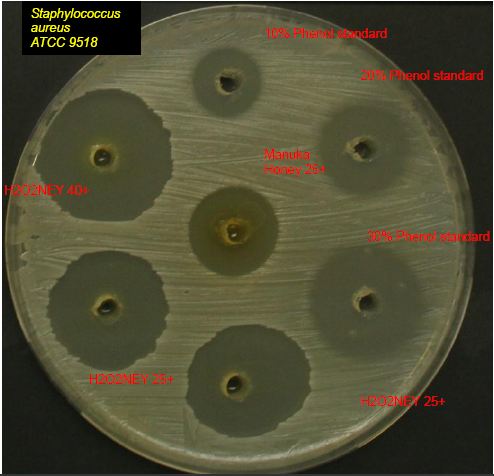
La miel de Ulmo esta en wikipeadia como alternativa para el control de los Staphylococcus aureus resistentes a la meticilina (SARM).
"A 2010 study noted significant antimicrobial action of Ulmo 90 and manuka UMF 25+ honey against several microorganisms, including MRSA. The investigators noted the superior antimicrobial action of Ulmo 90 honey, and suggested it be investigated further.[79] A separate 2010 study examined the use of medical-grade honey against several antibiotic-resistant strains of bacteria, including MRSA. The study concluded that the antimicrobial action of the honey studied was due to the activity of hydrogen peroxide, methylglyoxal, and a novel compound named bee defensin-1."
Lo interesante es juntar las pistas. El Ulmo 90, tal como nos imaginamos en ese posteo de septiembre hacía referencia a su contenido de polen y no a su actividad antimicrobiana.
Ahora nos enteramos que el Ulmo 90 es en realidad Ulmo +18, y que ese +18 es un factor de graduación de su actividad peróxica. De acuerdo a la propuesta de Healing Honey International sería el UHPF, que yo quiero imaginar - que así como la Manuka tiene su UMF (Unique Manuka Factor - el Ulmo chileno tiene su UlmoHoneyPeroxideFactor o UlmoHydrogenPeroxideFactor- UHPF. O la "P" será por phenol standard %. UlmoHoneyPhenolFactor?

La verdadera pregunta es como un Ulmo +18 pasa a transformarse en un Ulmo +40 como el de las fotografías de las placas petri?
Y ante todo la incertidumbre de si la miel de Ulmo logra su potencia solamente por su peroxido de hidrogeno o por sus fenóles como lo sugieren las patentes de Gloria Montenegro.
2. Uso de un extracto fenólico de miel unifloral de ulmo {Eucryphia cordifolia) de acuerdo a la reivindicación 1, CARACTERIZADO porque dicho extracto tiene efecto bacteriostático y bactericida contra Pseudomonas aeruginosa, Staphylococcus aureus, Streptococcus grupo B-Hemolítico, Escherichia coli, Salmonella typhi, Klebsiella pneumoniae, Klebsiella oxytoca, Staphilococcus epidermis, Enterobacter aerogenes, Bacillus subtillis, Bacillus cereus, Serratia marcescens, y fungistático contra Candida albicans, Saccharomyces spp, mucor, Aspergillus spp., Penicillium spp.
--------------
Staphylococcus aureus constituye un importante agente etiológico de diversas patologías infecciosas, entre las que destacan infecciones de piel y tejidos blandos, abscesos y septicemia1.
En 196l, Jevons2 describió por primera vez, en Londres, la aparición de cepas de Staphylococcus aureusresistentes a meticilina (SAMR), las que se han constituido en uno de los principales agentes de infección nosocomial a nivel mundial3.
En Chile, Lederman et al4 informaron por primera vez estas cepas en 1967. Desde entonces diversos autores han determinado una alta incidencia de infecciones por SAMR, especialmente nosocomiales, lo que implica un aumento en la morbilidad y mortalidad a nivel hospitalario5,6.
El mecanismo de resistencia a meticilina más importante lo constituye la síntesis de una nueva proteína fijadora de penicilina o penicillin binding protein (PBP), denominada PBP2a, la cual es capaz de mantener la integridad de la pared celular durante el crecimiento y la división celular cuando las PBPs habituales son inhibidas por los antibióticos fi-lactámi-cos". Esta resistencia se debe a la incorporación en el ADN bacteriano de un elemento extracromosomal que contiene el gen mecA, encargado de codificar dichas proteínas. La expresión fenotípica de esta resistencia suele ser heterogénea, lo que significa que, a pesar que todas las células de una población poseen el gen, sólo algunas lo manifiestan, haciendo difícil su detección en el laboratorio por los métodos habituales5.
http://www.scielo.cl/scielo.php?pid=S0034-98872007000500007&script=sci_arttext
sábado, julio 09, 2011
In the Big Leagues
 Del posteo anterior me dieron ganas de volver a visitar el esfuerzo de Rio San Pedro por llevar a nuestras mieles del Bosque Valdiviano a las grandes ligas de las mieles curativas.
Y la sorpresa fue más grande que el precio de exportación US$FOB 9.1 por kilo del posteo anterior.
Pero más impresionante aún los precios retail a los que se están vendiendo las Rainforest Active Honey y como están al ladito de la Manuka y las Jelly Bush de nuestros vecinos pacíficos.
También muy interesante la cobertura de prensa y la campaña de marketing en UK.
Ahora hay que confiar que la recepción del mercado comprador sea excelente y algo de este aumento de valor de la miel de Ulmo y Tineo sea traspasada a los productores locales. Si al final los apiarios de Apizur están al otro lado del cerro de las abejas de Río San Pedro.
Veamos si chorrea.
Por otro lado, viendo las diferentes mieles activas, entre +10 y +40 me hace preguntarme si cuando nos compren la miel nos pagaran distinto según lo activa que sea nuestra miel, y antes que eso conocer cuál es el método con el cual se medirá su actividad. Se abre un nuevo desafío para el mercado. Al menos en mi blog ya hay accesos por IT sligo.
miércoles, diciembre 29, 2010
Miel de Ulmo Cura Heridas
 http://www.radiobiobio.cl/2010/12/28/pacientes-de-hospital-de-temuco-se-sanan-con-los-beneficios-de-la-miel-y-la-vitamina-c/
En lo referido a la metodología del tratamiento, la enfermera detalló que las curaciones son realizadas de la misma forma que propone el Ministerio de Salud dentro de sus guías técnicas, con la diferencia de que los apósitos de alto costo son reemplazados por miel de ulmo, que cumple con las características ideales para el tratamiento de heridas.
miércoles, noviembre 17, 2010
Anti-bee-otics o de Cómo se crea una Marca?
 Ahora hay que ver si finalmente sube el precio de la miel de Ulmo y las otras que producimos en el Bosque Valdiviano muchos apicultores chilenos. Si es chileno es bueno, aunque el negocio lo hagan los extranjeros.
Otra del señor Corchete:
Scientists have discovered a remarkable ultra-pure honey which can kill MRSA and other lethal antibiotic-resistant bugs.
The sweet food can be used as a potent cream or added to wound dressings to blast stubborn bacteria.
Researchers believe it will transform the treatment of virulent hospital infections such as MRSA and E.coli and be on the market within two years.
It could also be put into sore throat lozenges or medicated chewing gum.
Dr James Brennan, who is working with a team of scientists in Ireland at Healing Honey International, said: "This is a natural product with supernatural powers. It's like a shotgun that blows micro-organisms out of the water.
"It has worked in thousands of trials and has the potential to reduce MRSA in hospitals significantly.
"It can kill particularly virulent bugs that antibiotics and conventional antiseptics are failing to have an effect on."
He added: "I have been a practising scientist for a number of years and it is very rare that you get the opportunity to say, 'Wow'. But this is a genuinely exciting breakthrough that could make a great contribution to world health."
Grown in an isolated region of southern Chile, the honey - called ActiveH2O2NEY - was found and developed by British horticulturist and beekeeper Ian Staples, 63.
It is free from pollutants and contains a range of natural properties including hydrogen peroxide.
Patente en NZ
(21) 587355 (22) 13 Aug 2010
(54) Antimicrobial Compositions
(51) A61K36/00; A61K38/44; A23L1/08
(71) Healing Honey International Ltd
(72) Barrett, John Reginald; Brennan, James Joseph; Patton, Thomas
Patrick; Staples, Ian Laurence;
(31) 1010944.5 (32) 29 Jun 2010 (33) GB
(31) 1013150.6 (32) 4 Aug 2010 (33) GB
(74) JAMES & WELLS, Level 12, KPMG Centre, 85 Alexandra Street,
Hamilton, New Zealand
Autoreferencia y buen marketing
El Equipo
cambio de direccion, socios
REGISTERED OFFICE CHANGED ON 18/10/2010 FROM; 45 JAY CLOSE; BICESTER; OXFORDSHIRE; OX26 6XN; ENGLAND...2010-10-18AD01DIRECTOR APPOINTED DR JAMES BRENNAN2010-09-21AP01ALTERATION TO MEMORANDUM AND ARTICLES2010-07-19RES01DIRECTOR APPOINTED MR IAN LAURENCE STAPLES2010-05-21AP01CERTIFICATE OF INCORPORATION; GENERAL COMPANY DETAILS & STATEMENTS OF;; OFFICERS, CAPITAL & SHAREHOL...2010-02-04NEWINC
| Company Name: | HEALING HONEY INTERNATIONAL LTD |
| Company Number: | 07146235 |
| Company Address: | 8 KING EDWARD STREET OXFORD OX1 4HL |
| Company Type: | Private Limited Company |
| Company Status: | Active |
| Company Industry: | None Supplied |
La investigación Sligo
Manuka Honey as a wound treatment
A HRB-funded project, examining the use of honey in the healing of wounds has made a potentially significant breakthrough in the battle against chronic wounds. Dr. Georgina Gethin initiated the study when she was a Clinical Nurse Specialist in Sligo General Hospital and was awarded a HRB Fellowship to conduct a RCT (Randomised Controlled Trial) using Manuka honey in the treating of chronic leg ulcers.
The effects of Active Manuka honey in the cleansing (debridement) and healing rates of wounds, as well as in antimicrobial activity, were compared to the effects of a standard hydrogel, both under compression, over a 12-week period. After the treatment period, it was determined that the group treated with honey experienced a higher rate of debridement (removal of dead, damaged, or infected tissue), significantly faster healing and reduced infection than in the group treated with the standard gel. Particularly striking in the study, was the information about effectiveness of Active Manuka Honey on wounds with Methicillin-resistant Staphylo
The Bussiness of Research
http://issuu.com/entirl/docs/
AN IRISH college has discovered there's money in honey
Sligo Institute of Technology has just signed a licensing agreement with a leading American company following research it conducted into manuka honey -- believed to have unique healing powers.
The institute research team isolated the curative properties of the honey and showed how they could be produced synthetically. Now HemCon plans to use the discovery for wound care, control of hospital-acquired infections and oral hygiene applications. It's also looking at other uses such as teeth whitening.
The research deal is worth at least $1m a year in royalties over the next 12 years to the Sligo Institute. Some of this will be ploughed back into further research and development at the institute.
The manuka discovery was made by a three-member research at the institute -- Drs James Brennan, John Barrett and Tom Patton.
"During their research into the curative properties of manuka honey they almost by accident discovered a particular synthetic way to produce the same effect and they were able to isolate this" said Niall McEvoy, innovation manager at the Institute.
HemCon, based in Portland, Oregon, aims to commercialise the product. Mr McEvoy said it was examining the possibility of the base product being manufactured in Sligo.
http://www.sligotoday.ie/
Algunas de las Patentes del equipo irlandes Sligo
http://www.wipo.int/pctdb/en/
http://www.freepatentsonline.
La compañia que les compró la idea
domingo, agosto 02, 2009
Maqui con Ulmo
¿Me pregunto de cuanto sirve el análisis polínico para determinar las propiedades de una Miel?. Efectivamente nos dará un indicio de su Origen Botánico y en grandes formaciones vegetacionales podriamos hablar de ciertos origenes geográficos (Denominación de Origen), en particular cuando se encuentran polenes de especies endémicas.
Pero no me dejo de preguntar como es posible encontrar en una miel de ulmo Eucriptia cordifolia, polenes de maqui Aristotelia chilensis, toda vez que entre la floración de ambas plantas han transcurrido más de 4 meses. ¿será sólo culpa del apicultor que cosechó todo junto al final de la temporada, incluso sacando marcos de la camara de cría con polenes reservado para el invierno?. Lo que queda claro de la lectura del resumen de la Tesis que comento, es que se puede sacar miel de Ulmo y miel de Maqui como mieles típificadas, monoflorales.
Me pregunto también si las virtudes antioxidantes del Jugo de Maqui - con un ORAC de 4000 por gramo - existirán en su nectar y/o en su polén? ¿se traspasa alguna característica del polen (por ejemplo sus esteroles) a la miel?
Pero no me dejo de preguntar como es posible encontrar en una miel de ulmo Eucriptia cordifolia, polenes de maqui Aristotelia chilensis, toda vez que entre la floración de ambas plantas han transcurrido más de 4 meses. ¿será sólo culpa del apicultor que cosechó todo junto al final de la temporada, incluso sacando marcos de la camara de cría con polenes reservado para el invierno?. Lo que queda claro de la lectura del resumen de la Tesis que comento, es que se puede sacar miel de Ulmo y miel de Maqui como mieles típificadas, monoflorales.
Me pregunto también si las virtudes antioxidantes del Jugo de Maqui - con un ORAC de 4000 por gramo - existirán en su nectar y/o en su polén? ¿se traspasa alguna característica del polen (por ejemplo sus esteroles) a la miel?
| Determinación del origen floral y caracterización física y química de mieles de abeja (Apis mellífera L.), etiquetadas como “miel de ulmo” (Eucriphya cordifolia Cav.) | |
| Díaz Caamaño, Carola Alejandra |
jueves, marzo 05, 2009
Muelas y Mieles
Interesante re valorar a través de la red, el esfuerzo de la universidad de la frontera UFRO, en el estudio de las mieles y propóleos en la salud dental. Tienen varias publicaciones cientificas, si bien trabajan con el necesario secretismo que les permita patentar los resultados. El Dr. Luis A. Salazar del Departamento de Ciencias Básicas de la Facultad de Medicina de la UFRO es quién lidera esta iniciativa.
http://www.med.ufro.cl/noticias/2008/julio/apicultura/index.htm
http://www.med.ufro.cl/noticias/2008/julio/apicultura/index.htm